Adaptive Space: How GM and Other Companies are Positively Disrupting Themselves and Transforming into Agile Organizations by Michael J. Arena
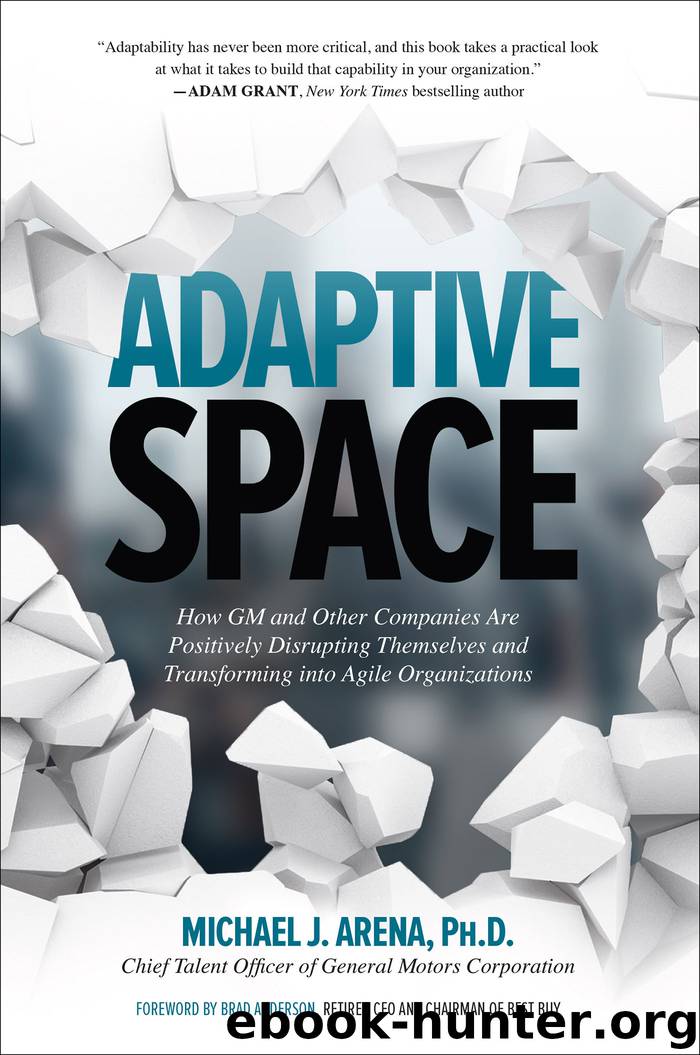
Author:Michael J. Arena
Language: eng
Format: epub
Publisher: McGraw-Hill Education LLC
Published: 2018-03-17T16:00:00+00:00
Finding Front Edge Users
Scientists have long marveled at how life flourishes on the edge where the sea thrusts upon the shore, creating the tidal pools. A diverse set of life-forms from mussels, to sea stars, to crabs and anemones lurk in beds of kelp and sea grass. These life-forms engage in a daily feast of food and oxygen. Algae and other intertidal plants grow in the abundant sunlight of the shallow waters, and the constant wave action supplies a rich source of nutrients and oxygen. Amidst pounding waves and powerful tides, these plants and animals are placed at great risk as they are frequently exposed to extreme conditions, such as summer’s broiling sun or winter’s freezing winds. The result of these edge exchanges is that more life originates and more mutations unfold in the tidal pool than any other place on earth. The same is true for agility; extreme edge users offer a richness of possibilities that simply doesn’t exist in the safe havens of day-to-day organizational existence.
Adaptive Space can act as a tidal pool that engages the extreme edge users—the geeks and freaks that live in the tidal pools of our world. These individuals have retrofitted or hacked products for their personal benefit, or perhaps they are using services for completely different reasons than their intended design. These are the people far from the center of the bell curve where the typical customer resides. They are often ignored because of their strange perspective or use, and yet they remain an incredibly valuable conduit for insight and learning based on their unusual perceptions. By connecting with extreme users of a given solution, we are often able to better understand undeveloped needs. That is, we can gain a deeper understanding of users’ needs by looking for shortcuts they have created or by examining how they have repurposed products.
A good example of this is found with mountain bike users, who sought to take their bikes onto mountain terrain and began creating their own solutions, well in advance of the bicycle industry, in order to do so. Traditional commercial bikes were not designed for rough terrain, so these extreme users began retrofitting their bikes with wider tires to provide better traction and makeshift brake drums to enhance their ability to stop. These edge users who designed mutant bikes for off-road adventure became the fertile terrain for agility within the biking domain that ultimately led to an entirely new industry. Indeed, entrepreneurship researchers Nikolaus Franke and Sonali Shah found that more than one-third of individuals who belong to extreme sports clubs have developed or modified commercial products, thus serving as rich tidal pools.6
By engaging extreme users, organizations are able to discover the future today, building bridges to new possibilities. Just consider 3M as one example. Researchers within the company were very interested in infection control, so they identified some extreme cases that fell beyond their target market.7 They looked at leading veterinary hospitals that had infection rates lower than those of some of the best human hospitals.
Download
This site does not store any files on its server. We only index and link to content provided by other sites. Please contact the content providers to delete copyright contents if any and email us, we'll remove relevant links or contents immediately.
Tools of Titans by Timothy Ferriss(8500)
Change Your Questions, Change Your Life by Marilee Adams(7852)
Deep Work by Cal Newport(7168)
Playing to Win_ How Strategy Really Works by A.G. Lafley & Roger L. Martin(6512)
Man-made Catastrophes and Risk Information Concealment by Dmitry Chernov & Didier Sornette(6144)
Digital Minimalism by Cal Newport;(5842)
Big Magic: Creative Living Beyond Fear by Elizabeth Gilbert(5837)
Ego Is the Enemy by Ryan Holiday(5532)
The Slight Edge by Jeff Olson(5470)
The Laws of Human Nature by Robert Greene(5328)
The Motivation Myth by Jeff Haden(5247)
Stone's Rules by Roger Stone(5133)
Tuesdays with Morrie by Mitch Albom(4859)
Eat That Frog! by Brian Tracy(4602)
Rising Strong by Brene Brown(4514)
Skin in the Game by Nassim Nicholas Taleb(4310)
The Money Culture by Michael Lewis(4268)
Bullshit Jobs by David Graeber(4253)
Skin in the Game: Hidden Asymmetries in Daily Life by Nassim Nicholas Taleb(4052)
